

When leaders ask employees to take more ownership, they usually want them to recognize problems, consider the options, make sound decisions, and follow through.
But do employees know which decisions they can make?
And do they know whether their manager will support them when someone disagrees?
These questions matter most when a customer challenges a charge, requests an exception, or expects a commitment that affects another department’s work.
A Scenario
Consider a project manager whose customer requests additional work outside the original agreement. The customer considers it a small request and expects the company to absorb the cost without changing the deadline.
The project manager reviews the agreement, estimates the additional labor, and checks the schedule. Completing the extra work by the original deadline could delay another customer’s project.
She brings her director two options:
Charge for the additional work and revise the completion date.
Reduce the additional work to preserve the original deadline.
She also explains the customer’s dissatisfaction and asks how to proceed.
The director offers to call the customer and handle it.
The director wants to protect an important account. An unresolved disagreement could cost the company future business.
Yet the project manager has done the preparation. Before taking over, the director needs to understand what help she actually needs.
Find Out What Is Holding the Employee Back
An employee who brings you a difficult situation may need information, approval, practice, or your support. Until you ask, you may not know which one.
In my Leadership Architecture™ program, participants practice using three coaching questions:
What do you recommend?
What options have you considered?
What support do you need from me?
The project manager has already answered the first two. The third could reveal her real concern.
She may feel comfortable presenting the options but wonder how far she can negotiate. She may also question whether her director will support her if the customer calls to challenge the answer.
If the director later waives the charge without involving her, she must explain why the answer changed. The next time a similar request comes up, she may send it straight to the director.
Before assuming she lacks confidence, find out whether she understands her authority and trusts that you will support it.
Be Specific About Decision Authority
A general instruction to use good judgment leaves employees to interpret what that means. Explain what they can decide, which requirements they must follow, and which decisions need your approval.
In Leadership Architecture™, I call these Decision Guardrails™.
For this project manager, the director can establish straightforward guardrails.
She can offer the additional work at the quoted price with a revised completion date, or discuss reducing the additional work to preserve the original deadline. She must confirm schedule changes with operations before making a commitment.
She cannot waive the additional charge, authorize overtime, or change another customer’s delivery date without the director’s approval.
The director also needs to share information that could affect the decision. For example, the company may have already granted this customer several concessions, or the agreement may require the customer to approve additional work in writing before the team begins.
Leaders sometimes forget how much information they have that employees do not. Give employees the information they need to make sound decisions.
Before ending the discussion, ask the project manager to briefly explain her planned approach. Together, they can identify and resolve any remaining questions.
Establish Escalation Triggers
Employees also need to recognize when a situation requires someone else’s authority.
Without specific guidance, one employee may call as soon as a customer objects.
Another may continue negotiating beyond their authority because they believe you expect them to handle everything themselves.
Agree on escalation triggers: circumstances that require the employee to involve you before proceeding.
In this situation, those triggers might include:
The customer requests a concession beyond the project manager’s authority.
A proposed solution would delay another customer’s project.
The customer threatens to cancel the contract.
New information raises safety, legal, or contractual concerns.
The customer threatens or verbally abuses the employee.
Explain what the employee should do when a trigger occurs. If the customer threatens to cancel, the project manager should pause negotiations, avoid making further concessions, agree on a response time, and contact the director.
Escalation does not automatically transfer the entire situation to the leader.
The project manager can still gather information, recommend a response, and follow up with the customer.
The director addresses the decision that requires additional authority.
Practice the Difficult Part
The project manager may understand the options yet still worry about the customer’s reaction.
Spend a few minutes practicing the part that concerns her. Have her respond to pressure to waive the charge, accusations that the company has treated the customer unfairly, or demands for an immediate answer.
Listen for whether she explains the additional work clearly and concisely, acknowledges the customer’s concerns, and presents the available options without promising something she cannot deliver.
Also practice how to pause when a request exceeds her authority. She needs to explain that she must review the request internally and give the customer a realistic response time.
A brief rehearsal can help her stay composed when the pressure increases.
Agree on Your Role Before the Conversation
If the project manager can handle the conversation herself, let her. Agree on an update afterward covering the customer’s response, the commitments she made, and any issues she still needs to resolve.
If she needs the director to join, clarify their roles beforehand. The project manager can explain the additional work and present the options. The director can provide support and address decisions that require approval.
Then give her room to conduct the conversation. A hesitation, an uncomfortable silence, or wording something differently than you would does not necessarily call for intervention.
Sometimes you will need to step in. Explain the reason afterward so the employee understands what to watch for next time.
Support the Authority You Have Given
Suppose the customer bypasses the project manager and calls the director directly.
If the director immediately waives the charge, the customer may learn that going around her produces a different answer. The project manager may also conclude that the director will withdraw her authority whenever a customer challenges her.
The director should explain that they reviewed the options together and include the project manager in any further discussion.
New information may justify a different decision. When it does, involve the project manager and explain what changed. This helps her understand the exception and make better decisions in the future.
Employees need to know that you will support their decisions when they follow the limits you established, including when someone dislikes the answer.
Review the Outcome and the Next Step
Afterward, review what happened. Discuss the customer’s objections, how the project manager responded, whether she stayed within her authority, and whether an escalation trigger occurred.
Identify any information or support she needed but did not have. Then decide what she can handle with less help next time.
Do not evaluate her performance solely by whether she pleased the customer. A customer may continue to object to the additional charge even when she handles the conversation well.
Look at whether she explained the options accurately, listened to concerns, respected the agreed limits, and followed through.
If she handled those responsibilities well, make the next step explicit. For a similar request, she can develop and present the options without reviewing them with the director first, provided she follows the same guardrails and contacts the director when an escalation trigger occurs.
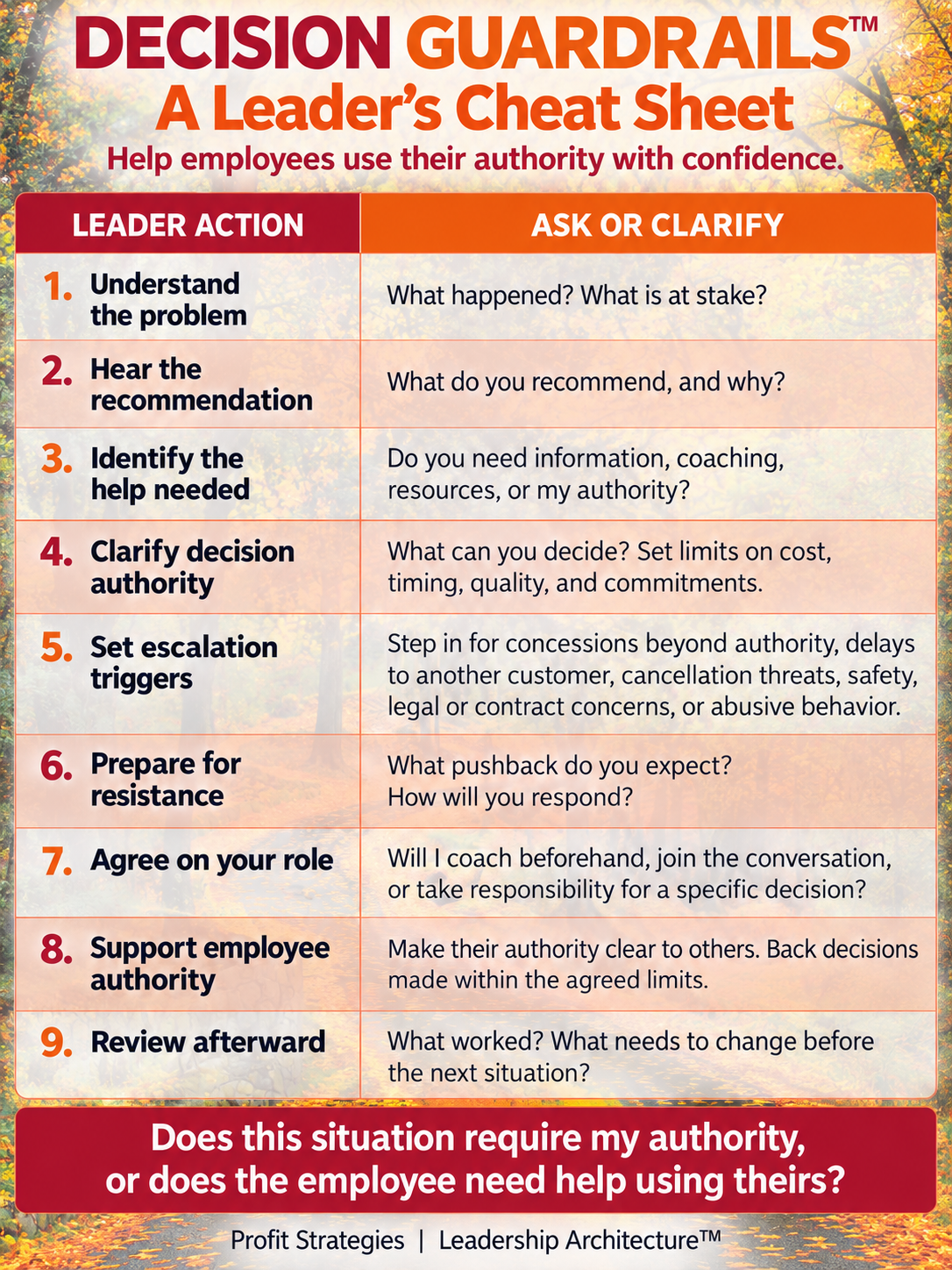
A Leader’s Cheat Sheet
Before taking over a difficult situation, work through these questions:
Could Your Team Handle It Without You?
In Leadership Architecture™, I use the Vacation Test™ to help leaders consider how their teams would perform if they were completely unavailable for two weeks.
For this director, the question is practical: Could the project manager handle the customer’s request, and would the customer recognize her authority?
If the answer is no, identify what she needs.
More practice?
Better information?
Clearer authority limits?
Does the director need to communicate her authority to the customer?
Choose one situation you regularly take over. Identify what an employee would need to handle more of it, then use the next opportunity to put that preparation into practice.
Before stepping in, ask yourself:
Does this situation require my authority, or does the employee need help using theirs?
Bonita Richter, MBA, is president of Profit Strategies, where she helps organizations develop leaders, strengthen teams, and improve business performance.